
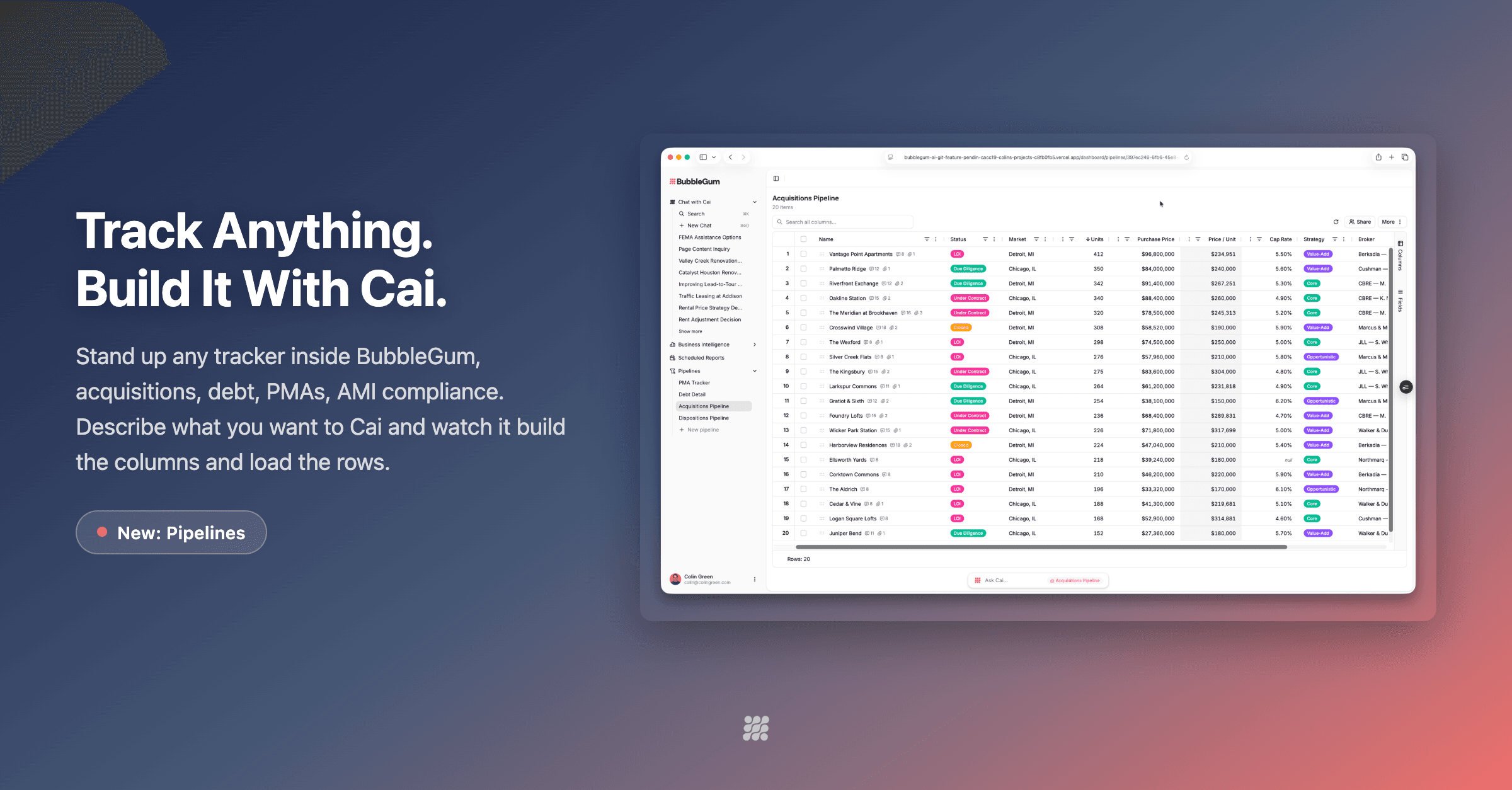
A multifamily pipeline tracker is a structured table for work that does not live cleanly in your PMS — acquisitions, debt, management agreements, development budgets, and AMI compliance — with stages, ownership, and a full change history on every row.
If your team is honest, the truth is already on shared drives: deal sheets, loan tabs, PMA calendars, construction budgets, and affordability matrices that never quite made it into Yardi or Entrata. That is not a failure of the PMS. It is a mismatch of jobs.
This guide maps the trackers institutional operators actually need, what “good” looks like, and how Pipelines inside BubbleGum — with help from Cai — replaces spreadsheet chaos without forcing every workflow into the PMS.
The PMS Is Not the Wrong Tool — It Is a Different Tool
Property management systems are built for leasing, resident accounting, and operational transactions. They are excellent at that job. They are a weak home for:
- Pre-close acquisitions with custom IC stages and broker coverage
- Portfolio debt schedules with covenant headroom and maturity walls
- Property management agreement (PMA) fee terms and renewal dates
- Development budgets with guidance vs actual and variance by line
- AMI limits, set-asides, and recertification calendars for mixed portfolios
When teams force these into the PMS, they either under-specify the workflow or invent parallel Excel. Purpose-built business intelligence solves performance analytics. Pipelines solve structured work that is not a lease or a GL entry.
What a Strong Pipeline Looks Like
Regardless of use case, high-functioning trackers share the same bones:
- Custom and formula columns — not a fixed template that ignores how your firm works
- Stages — first look → LOI → diligence → IC → close (or your equivalent)
- Comments and attachments — context travels with the row
- Full change history — who moved price, stage, or cap rate, and when
- Access control — share at the level you choose; export a branded copy when needed
If you cannot answer “what changed since last IC?” without opening email, you do not have a pipeline. You have a list.
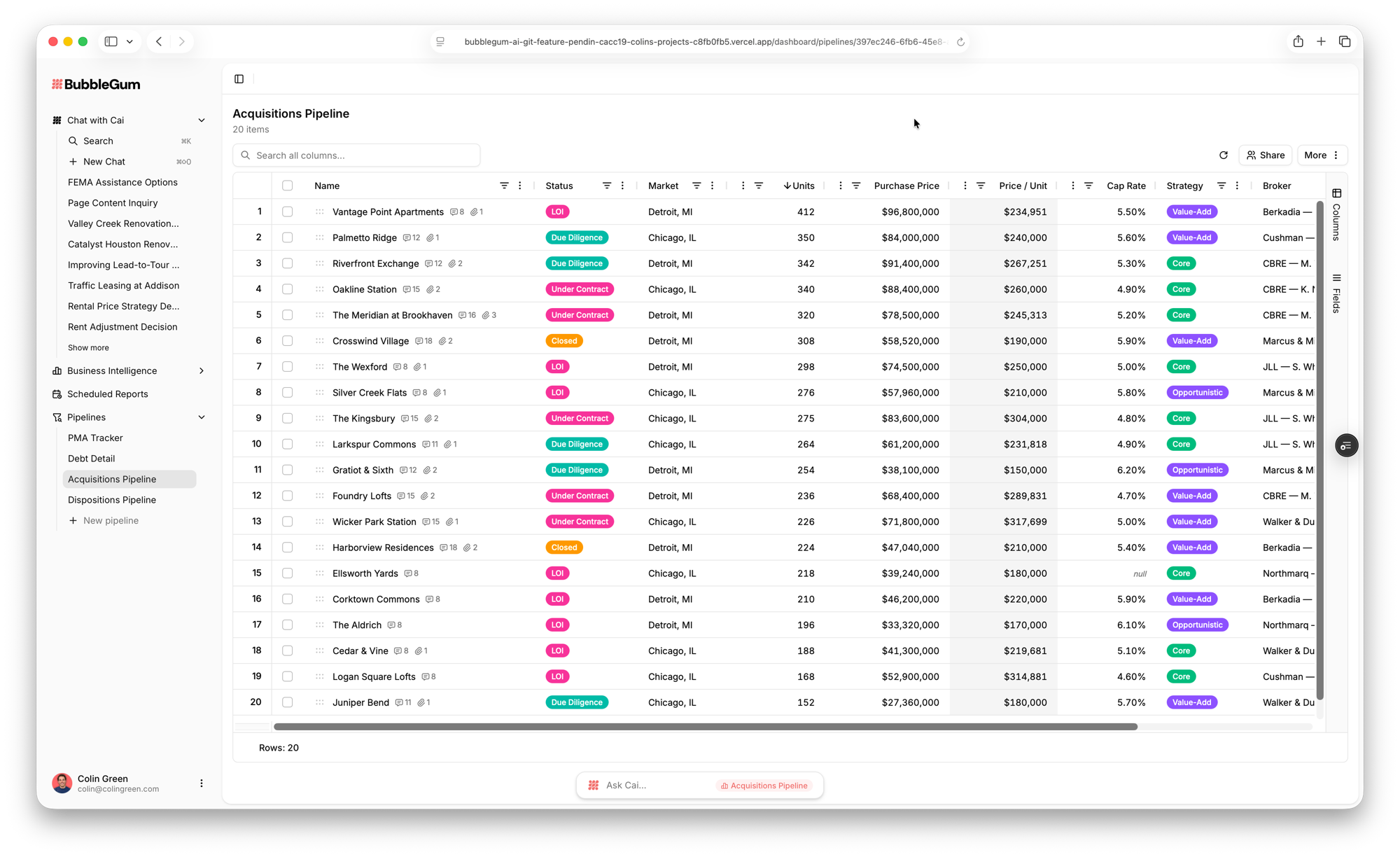
1. Acquisitions and Dispositions Pipelines
Every deal from first look to close needs a single source of truth: units, price, cap rate, stage, and broker. Owners and asset managers waste cycles reconciling three versions of the same bid list.
Good practice:
- Stage definitions that match your IC process, not a generic CRM
- Deal economics next to operational context you already trust from BI
- Disposition rows with the same rigor as buy-side — exits are pipelines too
Connect this to underwriting tools when you go deeper: cap rate, yield on cost, and DSCR calculators help standardize language across the team.
2. Debt Detail and Covenant Headroom
Loans, lenders, rates, and maturities do not belong in a forgotten tab. A debt pipeline keeps maturity walls visible and covenant headroom in view before a surprise call from the lender.
Track at minimum:
- Facility type, lender, rate structure, maturity date
- Outstanding balance and key covenants
- Headroom vs current portfolio performance from your financial analytics
Debt tracking is a board-level workflow. Spreadsheet version control is how covenants get missed.
3. PMA Tracker (Management Agreements)
Management agreements, fee terms, and renewal dates are commercial contracts with operational consequences. When fee structures and renewal windows live only in legal files, asset management finds out late.
A PMA tracker should surface:
- Counterparty and property coverage
- Fee basis and special terms
- Renewal / notice dates with owners assigned
4. Development Budget
Line items, guidance, and variance as a project moves — that is a pipeline with money attached. Development teams already live in cost reports; the failure mode is when asset management and capital partners cannot see the same grid.
Structure the budget so variance is first-class, not a monthly rebuild. Pair with value-add thinking from your value-add strategy work when renovations and development sit in the same firm.
5. AMI Limits and Affordable Compliance
Income limits, set-aside mix, and recertification dates by property exist so a unit never slips out of compliance. Mixed portfolios feel this acutely: market-rate muscle memory does not catch AMI drift.
Compliance trackers should make the next recert date as visible as occupancy. When leadership only sees portfolio occupancy, compliance risk stays invisible until it is expensive.
Stand up a pipeline from the sheet you already use
Custom columns, stages, history, and Cai-assisted setup — inside BubbleGum.
Schedule a DemoHow BubbleGum Pipelines Works With Cai
Pipelines is a tracking table you build yourself inside BubbleGum: custom and formula columns, stages, comments, attachments, and full change history. Drop in a spreadsheet you already keep and Cai stands up the grid, then reshapes it on command — for example, “group by stage and total the deal amounts.”
Share at the access level you choose and export a branded copy in your colors when partners need a clean view. That is the same branding philosophy as co-branded reports and dashboards: the work product should look like your firm.
Pipelines sit beside daily operations analytics and AI for multifamily diagnostics. Performance answers live in BI and Cai chat. Deal and compliance workflows live in Pipelines. Together they cover the real week of an institutional operator.
Getting Started Without a Six-Month Program
- Inventory the shadow sheets. Anything emailed weekly with “v7 final FINAL” in the name is a candidate.
- Pick one pipeline. Acquisitions or debt usually pay for the habit fastest.
- Define stages and owners. A row without an owner is a wish list.
- Import the existing sheet. Let Cai shape the grid; do not rebuild columns by hand first.
- Kill the parallel tab. Dual systems are how pipelines die.
Built by asset managers, for asset managers: the goal is not more software. It is one place where the work that never fit the PMS finally has structure, history, and share controls.
Frequently Asked Questions
What is a multifamily pipeline tracker?
A multifamily pipeline tracker is a structured table for work that does not live cleanly in a property management system — acquisitions and dispositions, debt detail, management agreements, development budgets, or AMI compliance — with stages, custom fields, comments, attachments, and change history.
Why don’t acquisitions and debt trackers belong only in the PMS?
PMS platforms excel at lease administration, accounting, and day-to-day operations. Deal pipelines, loan covenants, PMA fee terms, and development line items are cross-functional workflows with custom stages and stakeholders. Forcing them into the PMS usually creates shadow spreadsheets anyway.
What should a multifamily acquisitions pipeline include?
A practical acquisitions pipeline tracks every deal from first look to close with units, price, cap rate, stage, and broker, plus comments and a full change history so IC can see what moved and when.
How do teams track AMI and affordable compliance?
Strong AMI trackers hold income limits, set-aside mix, and recertification dates by property so a unit never silently slips out of compliance. That detail is hard to manage in ad hoc spreadsheets and incomplete in many standard ops reports.
Can AI help stand up a pipeline from an existing spreadsheet?
Yes. BubbleGum Pipelines lets teams drop in a spreadsheet they already keep; Cai stands up the grid with custom and formula columns, then reshapes it on command — for example, grouping by stage and totaling deal amounts.
Who needs shared access to multifamily pipelines?
Acquisitions, asset management, finance, and development often share the same tracker at different access levels. Controlled sharing and branded exports matter when brokers, partners, or owners need a clean view without full platform access.
Replace shadow spreadsheets with real pipelines
Acquisitions, debt, PMAs, development, and AMI — with stages, history, and Cai.
Schedule a Demo